The Side Project That Ate the Company: Pivot for the Right Reasons
These days I can hardly scroll through an online news stream for a minute before noticing a story about people joining the bandwagon of AI. Or a new form of Tech. Or some sort of horizontal, vertical, erratic SaaS model. Or whatever this week's wave is.
And every time I read one of these stories, I feel a weird, small, familiar tug. The thought arrives uninvited. Should I be doing that too? Should I keep working on what I am working on? Did I miss the bus already? OMG, how could I miss it? Will I be of any relevance anymore?
That's what FOMO (Fear of Missing Out) on steroids looks like in a business suit. And my bet is that quite a few of you resonate with this experience.
Be it a business decision or a career move, we always feel the grass is greener on the other side. Something shiny (as Smeagol would say, "My Precious") is always out there tempting us to stop doing what we are doing, change our direction, and join the brand new "Gold Rush."
The industry "cool" term for this act of changing direction (especially in the startup world) is "Pivot." A Pivot is defined as a fundamental shift or "strategic change" to your core offering. It's a move you make that alters how you create, deliver, or capture value. But as a working professional, pivoting from what you have been doing for years into a completely new field is frightening. It's not easy to start from zero when you are already ahead in a different race.
Having pivoted myself from the Creative Animation industry into the Technology and Digital Product space more than a decade ago, I know how hard and scary it is. I would also be the first person to admit that pivoting was one of the best career decisions I made. The work I have done in the last 10 years is some of my best work.
But I didn't change my career because of the excitement in my social feeds. I sincerely doubt that "Envy" is a good reason to change careers. I would not advise risking yours just because the opportunity looks attractive or popular or sounds like the next big thing. When the decision to pivot is backed by the right reasons, it can be one of your best.
That is exactly what happened in case of the two successful stories i want to share with you
Let's break bread first
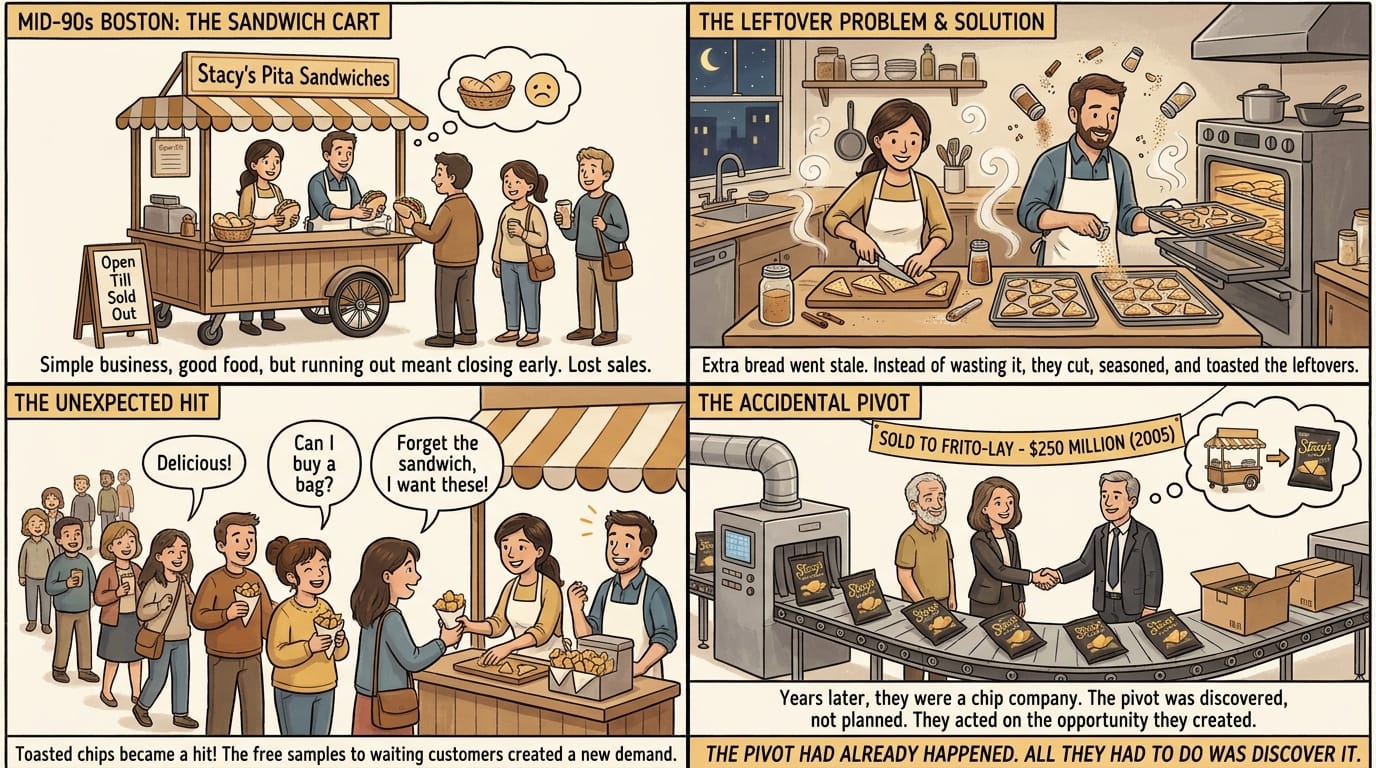
In the mid-1990s, Stacy Madison and her partner Mark Andrus were running a small pita sandwich cart in Boston. A simple no-brainer shop selling pita bread sandwiches with fillings at lunch times to a small set of hungry customers. The boring "mom and pop" style business.
The operation was simple. Open doors and sell till stock lasts. Their food was good, and before long they had a long queue of people lining up for their sandwiches. Things got busy fast. As the business picked up they had to rethink a small operational problem that mattered every single day.
If they ran out of bread by lunch, the shop closed. (Bread khatam, dhandha khatam.) The day's revenue stopped. They were letting disappointed customers walk away and leaving money on the table.
Like any good entrepreneur with a vision, Stacy and Mark committed to the business and decided to order more bread to make sure they would not stock out.
Better to have too much than to lose business. Right?
Stacy and Mark thought so too. But business, just like life, has the nagging tendency to get complicated. So now they had a different problem. Extra bread at the end of the day, going stale, which could not be used the next day.
The duo had to figure out what to do with this leftover bread. It did not feel right to throw it away as it was against their ethos. So they cut it into pieces, sprinkled cinnamon sugar or Parmesan, dried it down, and toasted it. The next day, they would hand out the toasted pita for free to customers waiting in line, to keep the queue happy.
The toasted bread became an instant hit, and the crowd loved it. People started asking if they could buy a bag or two.
Long story short.
Years later, Stacy and Mark had stopped making sandwiches. They were running a packaged pita chip business. In 2005, they sold Stacy's Pita Chips to Frito-Lay for a reported $250 million.(Raz, 2019; PepsiCo, 2006).
Did they plan to be a chip company? No.
They planned to be a sandwich company. The chips were what was left over from solving a problem they already had.
The pivot in their business was not a decision they made on a quiet Sunday morning, looking at the market. The pivot had already happened in their business. All they had to do was discover it at the right moment and act on it.
The Side Project That Ate an Agency
Hold on to that story for a bit and let me tell you one more, a little closer to my kind of scene, the digital tech space.
In the early 2000s, two friends in Atlanta started a small web design agency. Ben Chestnut and Dan Kurzius. They called it the Rocket Science Group. It was a standard hustle.
Build websites for clients, work like donkeys, ship on Friday (sometimes Saturday), do it again Monday.
The friends noticed that the clients kept asking for one annoying thing on top of the website work. Set up an email newsletter to run an email campaign and manage it for them on a weekly basis. It was tedious, repetitive setup work, and they hated it. So like any good developer team would, they decided to build a small internal tool to stop doing it by hand.
The tool sat in one corner of the business silently pushing emails for their clients for years. They did not care about it. The agency was the business. The tool was a workshop hack.
Then one of them decided to look at the numbers properly. The agency work was good. The invoices were big but the work was resource heavy, time consuming, and painful. The invoices for the tool were just a few dollars a month each, repetitive. They had deskilled the work completely and the effort required was negligible. And there was an ever-growing list of customers using this service. In short, the tool was quietly outperforming the agency on revenue per hour and was growing on its own without anyone really feeding it.
Once they noticed that, they shut the agency down and made the tool their entire business. The tool was MailChimp. Intuit acquired it in November 2021 for approximately $12 billion in cash and stock.
Two stories. Same pattern.
Both businesses found their actual product by accident, in the middle of trying to make a different business work. Neither founder team saw something on their Facebook feed one day, woke up the next morning, and said let's pivot. Both stumbled onto the real thing in the middle of a different kind of work, and had the discipline to notice it.
The Secret Sauce
What looks like luck, in the first two stories, is not. It was the consequence of being in motion. Of having shipped enough product, served enough customers, sold enough sandwiches, to have data on what was working and what was not.
Notice how Stacy and the MailChimp founders did not pivot because of FOMO. They pivoted because the small hacks ("Jugaad") they built to keep their business moving turned into a solution to a problem that showed more potential and scale.
Making the decision because your jugaad worked is very different from making a decision because of FOMO. In both cases it feels like opportunity. Feels like the universe is finally giving you a window. The same signals get triggered in your head. But they are entirely different beasts.
In FOMO, you see someone catch a wave. You decide you should catch one too. You jump. Not jumping feels like losing. The Bitcoin you didn't buy in 2013. The AI startup you didn't join in 2022. The agency niche you didn't pick last year. FOMO is binary. You bet and you win, or you bet and you lose, and either way the outcome had very little to do with you.
It is gambling, dressed up as decisiveness. Looks good when it works. Painful when it doesn't.
How Painful? I suggest you ask Katzenberg.
The TikTok Massacre
In April 2020, Jeffrey Katzenberg and Meg Whitman launched a short-form mobile video app called Quibi. The trend they were chasing was the gap between two giants. TikTok was winning short-form video on mobile. Netflix was winning premium subscription streaming. Quibi was supposed to be the third thing in the middle: Hollywood-grade video in five-to-ten-minute episodes, designed for the phone screen, sold by subscription, for the in-between moments of your day. Commutes. Lunch lines. Waiting rooms.
Before releasing a single episode, they raised $1.75 billion from Disney, NBCUniversal, WarnerMedia, Goldman Sachs, and a long list of others. They projected 7 million subscribers in year one. They got around 500,000. Six months after launch, they shut the company down. Most of the $1.75 billion was gone.
Quibi did not start from a problem the founders were living inside. It started from a thesis about a gap between two waves. They had a wave to catch, they raised against it, and the gap was not a business.
That's what FOMO can do to you.Jugaad, by contrast, is the process of figuring out a way when the actual problem in front of you needs solving but the existing solution is too slow, too expensive, not in your control, or out of reach. Stacy and Mark toasting the extra bread. Chestnut and Kurzius writing a small tool to stop doing email setup by hand.
Jugaad is not binary. It is incremental. You see it from the inside. From the outside, it looks like nothing.
Jugaad starts as a fix to a real problem, and sometimes the fix turns out to be the product. You are already dealing with the customers, watching the numbers, fixing what is broken today. Somewhere in that work, signal appears. It is usually small. The toasted bread that everyone keeps asking about. The side tool that no company thought of building before but every client wants.
Discovering that opportunity. That's your Pivot.
Discovery Is the Easy Half
Once you have found the opportunity, you have done about half the work. The other half is the part that wrecks most of us.
Stacy did not keep selling sandwiches once the chips were moving. The MailChimp founders did not run the agency and the product side by side, forever, hedging. They closed the agency. A working, profitable, paying-the-bills agency. And that is the moment most of us flinch.
How could we even think of letting go of our existing trajectory? We don't want to do that. We want to keep the safety net. We want to run both. We want to say yes to the new thing on Tuesday and Thursday, and still do the old thing on Monday, Wednesday, and Friday. We tell ourselves we are being smart. We are always trying to de-risk things.
But that is not how this works.
When we are doing two half-versions of two priorities, neither of them gets enough oxygen. Neither of them grows. The discovery you made in the work is wasted. You never actually commit to it. You just add it to your list.
Seth Godin has spent a career making the case for real commitment. I bet if he was writing this he'd say that a half-pivot is not a smaller pivot but just a confession that you weren't ready to commit.
Not many people have the bandwidth to do two things. So to pick up the new thing properly, you usually have to put the old thing down. That kinda commitment is what scares most people. And that is what separates the founders in the case studies from the ones who never end up in case studies.
The Question You Are Probably Avoiding
If you are reading this and thinking easier said than done, you're right. That's hindsight vision.
We are not the ones who've made pivots that have put us on the million-dollar pathways. The agencies that closed to bet on the product. The sandwich carts that became chip companies. Those are after-the-fact stories told in slow motion.
When these stories were playing out, I can bet that these people looked just like us. Confused. Half-committed. Distracted by the next shiny thing on the timeline. Yet, the moment they discovered that their jugaad worked, they were sure that it's worth letting go of what they had in hand and making the pivot.
If you want to do the same, you have to reflect back at your work to look for the problems that need solving. Figure out the jugaads. Somewhere in your current business, your current job, your current side project, there is something working in a way it was not designed for. A small thing customers keep coming back for. A tool you keep opening. A skill people keep asking you about for free. A piece of the work that is growing on its own, and you are too busy on the official roadmap to notice.
If pivots are discovered and not planned, then there are opportunities already existing in your work. You simply haven't paid attention to them.
The question is not what should you pivot to. The question is what is already pivoting under you as you scroll for something else?
The pivot you have been waiting for is not a bet you place. It is a signal you haven't discovered yet.
Sources
- Godin, S. (2007). The Dip: A little book that teaches you when to quit (and when to stick). Portfolio.
- Intuit. (2021, November 1). Intuit completes acquisition of Mailchimp. Intuit Newsroom. https://investors.intuit.com/news-events/press-releases/detail/154/intuit-completes-acquisition-of-mailchimp
- Legendary Exits. (n.d.). Exit unlocked: Building and selling a digital legacy — The Mailchimp story. https://content.legendaryexits.com/exit-unlocked-building-and-selling-a-digital-legacy-the-mailchimp-story/
- Mailchimp. (n.d.). About Mailchimp. Mailchimp. https://mailchimp.com/about/
- PepsiCo. (2006, January 13). PepsiCo completes acquisition of Stacy's Pita Chip Co. CSP Daily News. https://www.cspdailynews.com/snacks-candy/pepsico-completes-acquisition-stacys-pita-chip-co
- Raz, G. (Host). (2019, May 27). Stacy's Pita Chips: Stacy Madison [Audio podcast episode]. In How I Built This with Guy Raz. Wondery. https://wondery.com/shows/how-i-built-this/episode/10386-stacys-pita-chips-stacy-madison-2019/
- Spangler, T. (2020, October 21). Jeffrey Katzenberg and Meg Whitman's Quibi considers shutting down (Report). Variety. https://variety.com/2020/digital/news/quibi-considers-shutting-down-jeffrey-katzenberg-meg-whitman-1234812313/